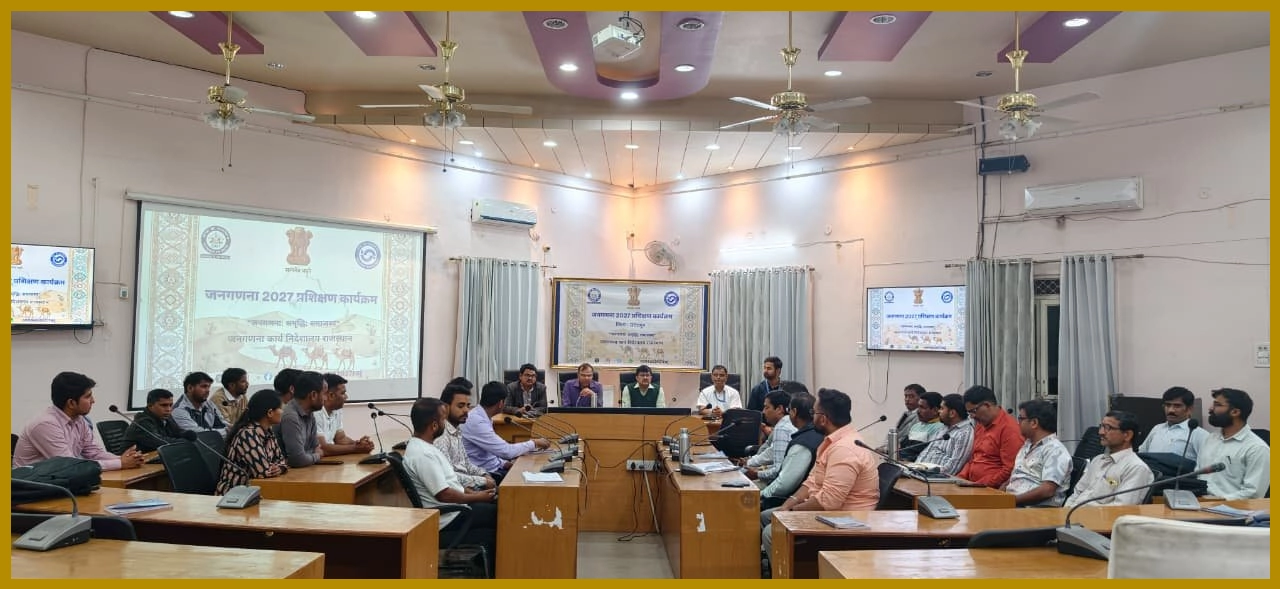
Udaipur, February 19: A three-day training session for regular assistants involved in the first phase of the 2027 Census concluded at the District Council auditorium. State-level trainers Mahendra Kumar Meena and Dwipendra Dhabhai, appointed by the Census Directorate in Jaipur, conducted the training. The first two days focused on theoretical aspects of house listing and enumeration, while the final day included practical training where participants tested their knowledge on the HLBCC portal. An online assessment was conducted post-training to evaluate all participants.
In the closing session, Additional District Collector (City) Jitendra Ojha emphasized the importance of initial information and precautions necessary for the house listing block census work. Each census block is expected to have a population of 700 to 800 or 150 to 180 houses. The role and responsibilities of regular assistants are crucial for the successful completion of the house listing task. They will create maps of enumeration blocks using satellite imagery, aiding enumerators and supervisors in physical verification, house listing, and census activities.
Puneet Sharma, the Sub-District Census Officer from the nodal department of Economic and Statistics in Udaipur, highlighted that this initiative marks a historic shift from traditional paper-based methods to a fully digital framework, reflecting the government’s commitment to minimal governance and maximum efficiency. The 2027 Census is not merely a statistical exercise; it is the backbone of policy-making for India’s future. The aim is to establish the census as a service to ensure no citizen is left behind in the nation’s development journey. Ground-level digital proficiency is key to success. Rajendra Khatik, Assistant Director of the Statistics Department, discussed the importance of the Census Management and Monitoring System (CMMS) portal for data integrity, privacy, and real-time tracking, ensuring complete confidentiality of citizen data under the Census Act of 1948.